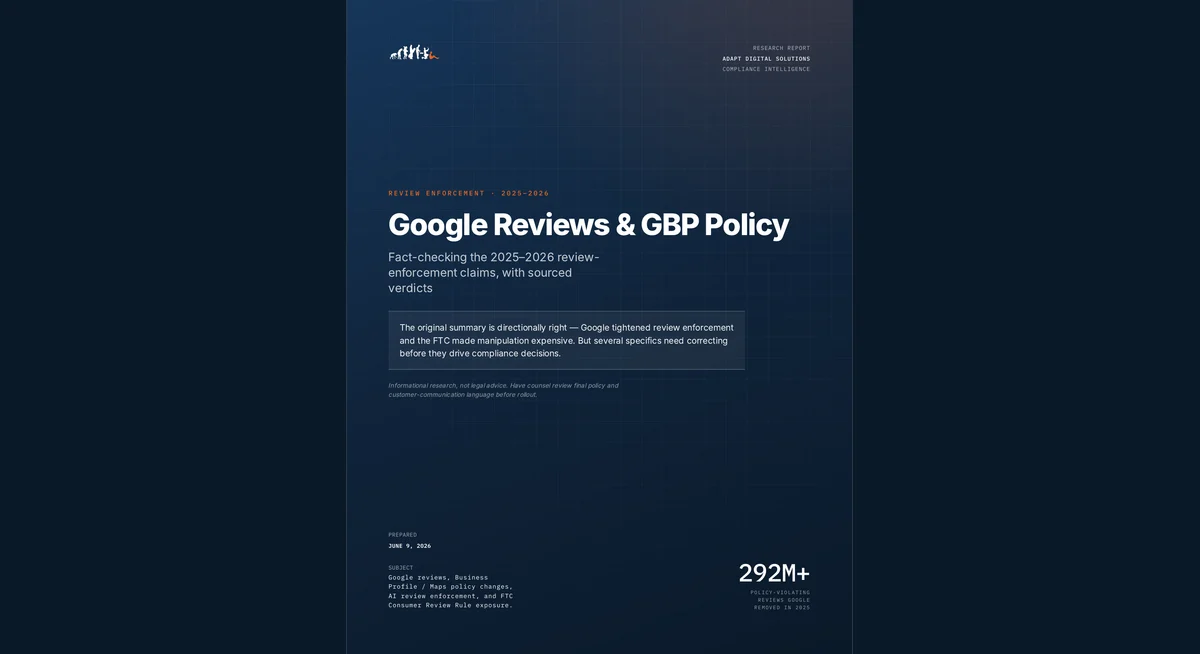
If you run a local business or manage marketing for one, you’ve probably seen the alarming posts: “Google banned staff names in reviews,” “Gemini deleted 292 million reviews,” “review deletions are up 600%,” “post weekly or lose your ranking.” Some of that is true. Some of it is half-true. And some of it is the kind of myth that gets repeated until everyone believes it.
So we did the boring, useful thing: we went to the actual Google policy pages and the actual federal regulations, read them line by line, and checked every claim. What follows is the plain-English version of everything we found.
Here’s the headline: Google really has tightened review enforcement, and the FTC really can fine you now. But the safe way to operate is simpler than the panic suggests. A few of the scariest claims don’t hold up at all.
The 7 corrections that matter
The version most people are repeating is directionally right but sloppy on the details, and the details are where compliance decisions get made. Here’s what to fix:
- “Staff mention ban” is misleading. Google bans merchants directing staff to solicit reviews with specific content (including content that identifies a staff member). A customer voluntarily writing “Sarah was helpful” is a different thing.
- The April 17, 2026 policy change is real. New staff-quota and staff-identity clauses appeared in Google’s Rating Manipulation policy; the official Help page is the source of truth.
- Google’s 2025 enforcement numbers are real: 292M+ reviews removed, 79M edits blocked, 782K+ accounts restricted, 13M+ fake profiles removed.
- “Gemini removed 292M reviews” is overstated. Google ties Gemini specifically to catching fake/unhelpful edits faster; review enforcement is described as AI systems plus human analysts.
- The “600% increase” is third-party data, not an official Google statistic. It is useful as a signal, but it is not a Google-confirmed number.
- “30+ days dormant = lost visibility” is unsupported as a hard rule. Google rewards accurate, active profiles, but publishes no 30-day penalty.
- The $53,088-per-violation FTC fine is real, and the legal standard is broader than “actual knowledge.” It includes knowledge fairly implied from objective circumstances.
What Google actually changed in 2025–2026
Three real shifts are driving all of this:
1. Q&A is becoming AI “Ask.” Google discontinued the My Business Q&A API on November 3, 2025, and has been moving the old customer-facing Q&A toward an AI-powered “Ask” experience. Its March 2026 “Ask Maps” announcement confirms Maps now answers conversational questions using place data and reviews. Practical takeaway: accurate, consistent info across your profile, website, and reviews increasingly feeds those AI answers. That is not a license to stuff keywords into reviews.
2. The Rating Manipulation policy got teeth. Around April 17, 2026, Google added explicit language about staff review quotas and reviews that identify staff members. This is the controlling document for almost every “is this allowed?” question.
3. Enforcement went industrial. In its April 16, 2026 Maps safety post, Google said that in 2025 it blocked or removed 292M+ policy-violating reviews, blocked 79M bad edits, restricted 782K+ accounts, and removed 13M+ fake Business Profiles. The scale is the point. Manual, scripted review schemes are getting caught.
The claims, fact-checked
Here’s the verdict table in short form. Each row pairs the claim with what the actual Google or FTC source says.
| Claim | Verdict | The reality |
|---|---|---|
| Google replaced GBP Q&A with an AI “Ask” button | Mostly confirmed | Q&A API ended Nov 3, 2025; Ask Maps confirmed by Google. |
| The Dec 2025 Core Update caused review removals | Unsupported | Core updates are a Search system. No tie to Maps review removal. |
| FTC sent its first review-rule warning letters Dec 22, 2025 | Confirmed | Letters to 10 companies; 5-business-day response demanded. |
| Review deletions up 600%, still 400% above normal | Partial | Third-party (GMBapi) monitoring, not a Google statistic. |
| Customers can’t mention employees by name | Misleading | It targets merchant solicitation, not voluntary mentions. |
| Review quotas are banned | Confirmed | Asking staff to get a set number of reviews is prohibited. |
| Incentivized reviews are banned | Confirmed | Google and the FTC prohibit incentives tied to reviews. |
| 292M reviews / 13M fake profiles removed in 2025 | Confirmed | Straight from Google’s April 2026 Maps post. |
| Those 292M actions were “using Gemini AI” | Misleading | Gemini is credited for edits; reviews = AI + analysts. |
| Real photos only; no AI-generated images at all | Partial | Real media favored, but Google offers its own AI image tools. |
| Dormant 30+ days = lost visibility; post weekly | Unsupported | No such rule in Google’s ranking guidance. |
| FTC penalties up to $53,088 per violation | Confirmed | 16 CFR § 1.98 current adjustment. |
What’s now clearly risky or banned
Google’s Rating Manipulation policy says merchants should not:
- Offer payment, discounts, free goods/services, or any incentive for posting, changing, or removing a review.
- Discourage or prohibit negative reviews.
- Selectively solicit positive reviews. This is review gating, and it is no longer allowed.
- Require or pressure customers to review while they’re on the premises (this is why front-desk kiosks and shared tablets are a problem).
- Ask for specific content to be included in a review.
- Ask staff to solicit a certain number of reviews (quotas).
- Ask staff to solicit reviews that identify a staff member.
What’s still fine: asking every eligible customer for an honest review, neutrally, with no incentive and no script. The line is manipulation: shaping what they write, who you ask, when you ask, or whether they get rewarded for it.
The FTC angle: $53,088 per violation
This is the part most local businesses underestimate. The FTC’s Consumer Review Rule has been fully effective since October 21, 2024, and on December 22, 2025 the FTC sent warning letters to 10 companies. Civil penalties can reach $53,088 per violation (16 CFR § 1.98).
The “they have to prove we knew” defense is shakier than it sounds. The standard is actual knowledge or knowledge fairly implied on the basis of objective circumstances. The rule targets fake reviews, sentiment-conditioned incentives, undisclosed insider reviews, fake “independent” review sites, and certain review suppression. Treat this as a legal-risk issue, not only an SEO one, and have counsel review your final policy language.
Three myths to stop repeating
Myth 1: “Gemini removed 292 million reviews.” The number is real; the attribution isn’t. Google credits AI systems and human analysts for review enforcement, and names Gemini specifically for catching bad edits faster.
Myth 2: “Deletions are up exactly 600%.” That comes from a third-party monitor (GMBapi) tracking how many locations saw at least one deletion in a week, a figure that rose more than sixfold in early 2025. It’s a real signal, but it is not a Google-wide deletion rate.
Myth 3: “Post every 30 days or lose ranking.” No official Google source supports a 30-day dormancy penalty or a weekly-posting rule. Local ranking is relevance, distance, and prominence. Keep your profile current because it converts better, not because of a penalty that doesn’t exist.
What to actually do (the safe playbook)
If you change nothing else, change these:
- Ask every eligible customer the same neutral way. Don’t filter by sentiment.
- Stop scripting reviews. That means no star-rating requests, no keywords, no staff names, and no “mention me.”
- Kill quotas and contests tied to review count, rating, or staff mentions.
- No incentives for leaving, changing, or removing a review.
- Stop collecting reviews on store-owned tablets/kiosks or while standing over the customer. Send a neutral link by text or email after the visit.
- Use real photos and keep your profile accurate and current.
A safe request looks like this:
“Thank you for choosing us. We value honest feedback from all customers. You can leave a Google review here: [link].”
That’s it. Real customers, neutral asks, no incentives, no gating, no scripts, real photos, accurate info. None of these principles are new. What changed is the enforcement behind them, which is now more automated, more visible, and far more expensive to get wrong.
This article is informational and not legal advice. For FTC or regulatory exposure, have counsel review your final policy and customer-communication language before rollout.