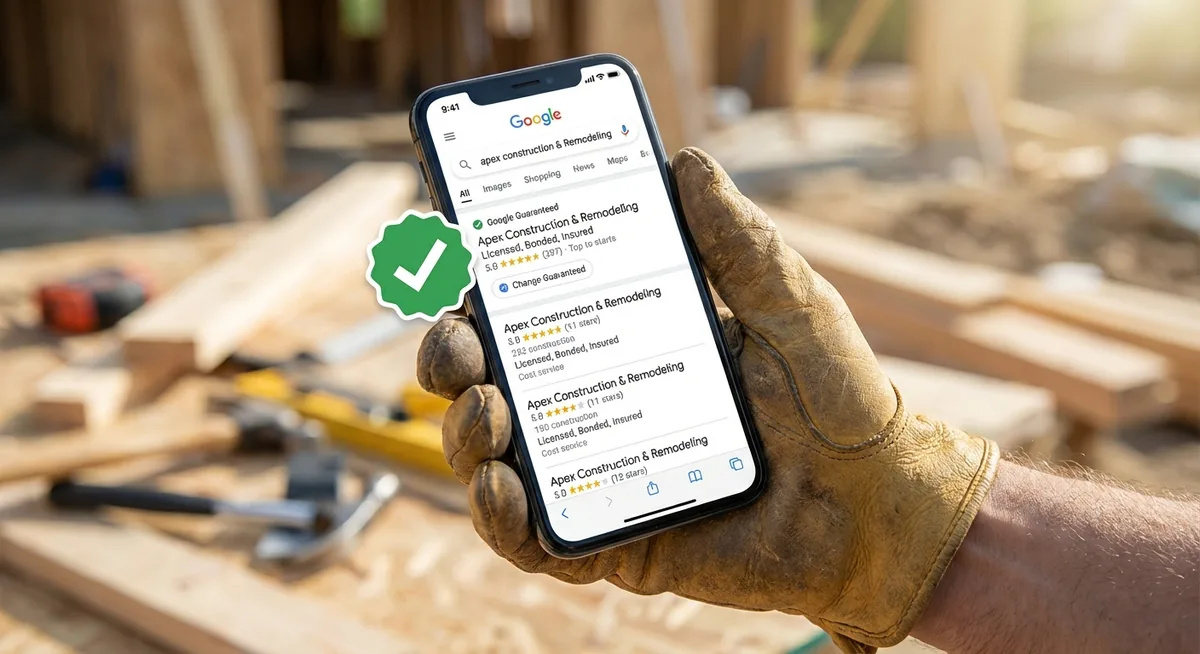
I've been managing Google Local Service Ads accounts for contractors across the country for years now. Dozens of them. Different trades, different markets, wildly different results — and after all of it, I still get the same questions.
How much does a lead cost? Which trades work best? What should my budget be? Is it even worth it?
The honest answer to most of those questions is: it depends. But that's not a cop-out. I'm going to explain exactly what it depends on and give you the real framework I use to set expectations for every client I bring on. Because the contractors who get burned by LSA usually get burned for the same reasons — reasons that are completely avoidable if you understand how the platform actually works.
What Is Google Local Service Ads?
Google Local Service Ads show up at the very top of search results — above regular Google Ads, above the map pack, above everything. When someone searches "plumber near me" or "electrician in Coeur d'Alene," the first things they see are LSA listings with a badge, a phone number, and your reviews front and center.
The key difference between LSA and regular Google Ads: you pay per phone call, not per click. If nobody calls you, you don't spend anything. That makes it fundamentally lower risk than traditional pay-per-click advertising.
To get on LSA, you go through a verification process — background check, license verification, insurance confirmation. Google's way of vetting who shows up at the top of their results. It takes two to four weeks on average. Sometimes faster, sometimes longer. As long as you don't give up on the process, you'll get through it eventually.
What's Changed Since 2024
One notable update: Google has automated the lead dispute process. Before, if you got a bad lead — a spam call, wrong number, someone looking for a service you don't offer — you had to manually go in and request a refund. Now it's handled by AI, and in my experience it works about 90% of the time. That's a real improvement. You're still keeping an eye on your account, but Google's doing more of the cleanup automatically now.
The core mechanic of LSA — how Google decides who gets calls, how bidding works, how reviews factor in — all of that operates essentially the same way it has. The platform isn't broken. What changes constantly are the market conditions around it.
How Google Decides Who Gets the Calls
This is the part most contractors don't think through, and it's the most important part to understand.
Put yourself in Google's shoes for a minute. You're the middleman between homeowners searching for a contractor and contractors willing to pay for those calls. Your actual customer — the one you care most about — is the person searching. They're using your platform for free, and you want to send them to the best possible contractor.
So who would you send calls to? I'd send calls to contractors who:
- Have money to spend — and have proven it by spending consistently over time
- Answer the phone professionally — every time, every call
- Are consistent — not here today, gone next month, back next quarter
That's how Google thinks about it. And that tells you exactly how to play the game. The variables you can control are your bid per call, how consistently you maintain your account, how quickly and professionally you respond to every call, and how strong your review count is.
The variables you can't control — and that have the biggest impact on your results — are your market. Specifically: how many people in your area are searching for what you offer, and how many other contractors are competing for the same calls.
The Supply and Demand Reality
This is the honest truth about LSA costs, and I want to give you a real example instead of vague advice.
I have two clients who both sell garage doors. Similar businesses, similar services. One of them pays around $15 per lead and gets multiple leads every day. The other pays around $80 per lead and gets far fewer calls. Same platform. Same type of contractor. Dramatically different results.
The only real difference? The number of competitors buying calls in each area.
That's it. One of them is in a market where not many contractors are bidding on garage door calls, so the calls are plentiful and cheap. The other is in a more competitive market, so calls are scarce and expensive. Neither one is doing anything wrong. The market literally sets the price.
So when people ask me, "How's LSA going to work for me?" — my honest answer is: I don't know. And nobody knows until you actually try it. That's not me being evasive. That's just how marketing works.
Think of it like fishing. You can go to the same lake every week, know the good spots, have years of experience — and still not know exactly what you're going to catch that day. Some days you pull in a bunch of big ones, some days you go home empty. The lake is Google. The only way to know what's in your lake is to go fishing.
What Does a Lead Cost on LSA Right Now?
Across the accounts I manage, I've seen lead costs ranging from $15 to over $300 — sometimes for the same trade in different markets.
Water damage restoration tends to be at the high end — $300+ per call — because contractors in that space are willing to pay for it. The jobs are big, so the math makes sense. Handyman work tends to come in at $15–$30 per lead because the competition is lower and the service area is often more local.
But here's the bigger point: people get too hung up on cost per lead as the metric that matters. It isn't. The number that matters is cost per job — and whether that cost fits into your pricing.
Let's say calls cost you $100 each and it takes 10 calls to close a job. That's $1,000 to get a job. If you do remodeling and your average project is $15,000, that's not a problem. Add the marketing cost into your pricing, or absorb it into your margins — either way, the math works. But if you're doing $500 handyman jobs and paying $1,000 to acquire each customer, that channel doesn't work for you and you move on.
Track your numbers. Price your marketing costs into what you charge. Your customers are actually the ones paying for your marketing — you're just the middleman.
The Biggest Mistake Contractors Make With LSA
Setting the budget too low. I see it constantly, and it kills results every time.
Someone signs up for LSA, sets a budget of $50 a week, gets zero calls, and concludes that LSA doesn't work. But in their market, calls cost $80 each. Their weekly budget isn't enough for a single lead. They've pre-failed before they started.
My standard advice: set your budget at $1,000 per week when you start. Most of the time, especially in less competitive markets or when you're brand new to the platform, you'll only get a few calls and spend a fraction of that. But the ceiling is high enough that Google knows you're serious, and you're not accidentally sandbagging yourself.
Once you're running, watch your account daily. You'll see exactly how many calls you're getting and what each one costs. Then adjust from there. But don't start scared. Contractors who are afraid to spend $100 on leads often aren't ready for paid advertising yet — and that's okay. Know your numbers first.
The question to ask yourself before you start: what can you afford to spend per job? If your average job is worth $8,000 and your margins are solid, you can probably spend $500–1,000 to get that job and still come out way ahead. Map that out on paper before you log in to LSA.
Which Trades Work Best on LSA?
Honestly, this is the wrong question. It's less about which trade you're in and more about whether you're in a market with demand and low competition.
I know a handyman business — handyman, not exactly a high-margin premium trade — that gets over 400 calls per month across a few locations from LSA. That's not because handyman work is special on LSA. It's because that contractor got in early, built a strong Google profile, maintained their account consistently, and happened to be in markets where not many others were doing the same thing.
And because you only pay when you get a call, there's minimal risk in trying. If your market is saturated and you barely get any calls, you barely spend any money. The downside is the time and frustration of setting it up. The upside can be genuinely life-changing volume.
LSA and Your Google Reviews — The Connection Most People Miss
LSA uses your Google Business Profile reviews. This is critical and a lot of contractors don't realize it.
If you have 8 reviews and your competitor has 200, Google is going to favor them in LSA. Not just in rankings — customers clicking on LSA listings are also looking at your review count and star rating before they call. A thin review profile hurts you twice: once in how Google ranks you, and once in whether the customer actually picks up the phone to call.
Even the people who see you through LSA will often still Google your business name, look at your reviews, and check your website before they call. The foundation matters just as much as the advertising on top of it.
Where LSA Fits in Your Marketing Stack
This is the order I recommend for most contractors:
Step 1 — Build the foundation: Your website, your Google Business Profile, your reviews. This is non-negotiable. It takes longer to pay off, but it compounds over time and doesn't require you to keep paying to keep it going. Organic leads are also higher quality than paid leads — people who find you naturally are usually further along in the buying decision.
Step 2 — LSA: Once your foundation is solid, LSA is the logical first advertising channel. Low risk, pay-per-call, no wasted spend on clicks that don't convert. It works best when you have a competitive review count, because your reviews power your LSA performance.
Step 3 — Google Ads: Once LSA is maxed out and you want more volume, that's when you move into traditional pay-per-click Google Ads. More complex, higher cost, but more control over targeting and volume.
You can run all three simultaneously. But if you're starting out, or working with a limited budget, that's the order that makes the most sense. Foundation first. LSA second. Google Ads when you're ready to pour fuel on the fire.
Should You Try LSA?
Yes — with your eyes open.
If you've got your Google Business Profile set up, you have a reasonable number of reviews, and you can handle incoming calls promptly and professionally, LSA is worth running. The downside is capped by how few calls your market delivers. The upside is as high as 400 calls a month, or more.
Just go into it understanding that no one can tell you exactly what you'll get. Not me, not Google, not anyone. The only way to find out what's in your fishing hole is to go fishing.
Set your budget properly, watch your account, track your cost per job, and give it a real shot. If it works, you'll know. If it doesn't, you'll know that too — and you won't have spent a fortune finding out.
If you want help setting up or optimizing a Local Service Ads account, or you want us to look at your Google profile before you start spending money on advertising, reach out to Adapt. That's exactly what we do.
Related: How to Get Google Reviews From Every Single Job · How I Get Customers for My Construction Business · How Contractors Find Jobs: What Actually Works