Do not start by buying a wrap, a new truck, software, and ads. Start with research.
Quick note: this guide assumes you already know your trade. If you do not, the better move is to work for someone first and trade labor for learning before you try to sell the work yourself.
I mean real research for your trade, your state, and the first jobs you plan to sell. Type, "I want to be a handyman in Idaho. What do I have to do legally?" Then verify it with the state, city, county, and a contractor insurance person.
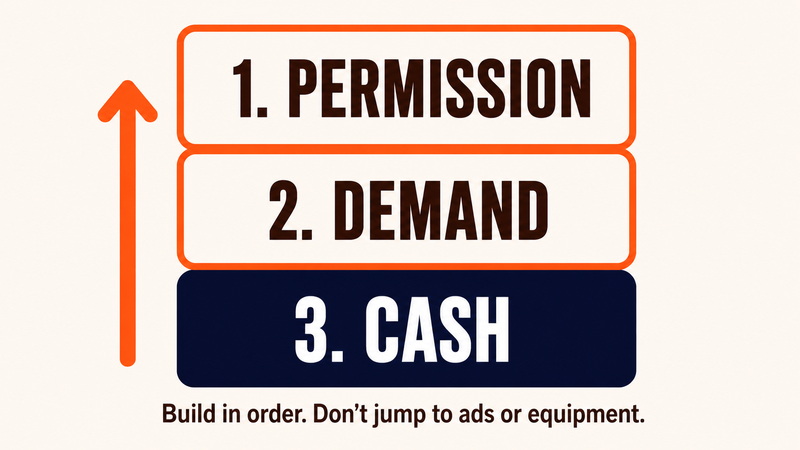
The order is simple:
- Know the rules.
- Get legal enough to do the work you are selling.
- Get in front of people.
- Price every job so it makes money.
A lot of guys hide behind paperwork. They say, "I need an LLC first." Most of the time that is procrastination in a nicer shirt.
Build in order before you buy equipment, software, or ads.
Plain-English definitions
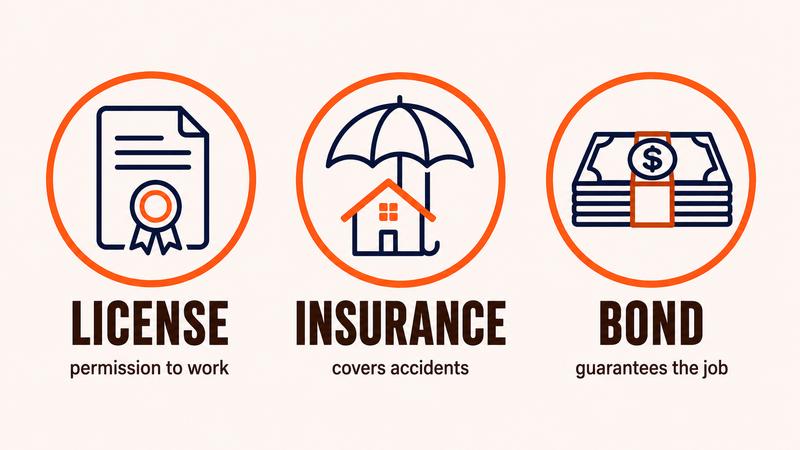
- License: permission from the state or local board to do a certain kind of contractor work.
- Registration: putting your business or contractor name on the official list so the state knows who is doing the work.
- Permit: approval for a specific job or part of a job, usually from the city or county.
- Insurance: a policy that helps pay for covered accidents, injuries, or damage.
- Bond: a guarantee from a bonding company that protects the customer or owner if you fail to meet the rules or finish the work.
- Bond vs insurance: insurance is mainly there for covered losses. A bond is mainly there as a promise to someone else, and the bonding company may come back to you for repayment.
- Reciprocity: when one state gives some credit for a license you already earned in another state.
- Workers comp: insurance for employees who get hurt on the job.
- LLC: a legal business structure. It can help separate business risk from personal assets, but it does not erase your own bad work.
- Sole proprietor: one person doing business under their own name or a trade name, without forming a separate company.
Permission to operate
Before you sell regulated work, know what the law actually requires. A business license is not a contractor registration. A contractor registration is not a trade license. General liability is not workers comp. A surety bond is not insurance for you. It is a guarantee to the customer or owner that the work will be completed.
Separate the legal permission from the risk protection.
Do not use a national checklist as your final answer. Local rules change by state, trade, job size, and customer type.
Here is where I split from the normal advice. I do not think most new contractors need to sprint into an LLC first. Depending on local rules, you may be able to start as a sole proprietor under your own name. Keep your books clean: money in, money spent for the business, and money left over for taxes.
An LLC can protect personal assets in some situations. But if you are a one man operation and you personally do negligent work, like burning down a customer's house, do not think the LLC magically makes you untouchable. You did the work. You are still in the mess. In my view, LLC protection matters more once you have employees and assets worth protecting.
If you will file the LLC, pay the fees, and keep up with annual reports, fine. Just do not use it as the excuse that keeps you from a paying customer.
Idaho is a good example of why you verify the details. Idaho says contractors are registered, not licensed, and registration is required for a construction job exceeding $2,000 in materials and labor unless an exemption applies. Idaho also ties registration to insurance proof and requires registered contractors to show their registration number in advertising and job paperwork. So if you are fixing a deck, research the rule and work inside it. Know the floor, then move.
Licensing difficulty: the 5 easiest and 5 most difficult states to operate in
We pulled this from our own state licensing articles, and I would use it as a starting map, not a shortcut. Easy does not mean you can ignore city rules. Difficult does not mean impossible. It just means the paperwork and proof come earlier.
Easiest states to operate in
- Idaho: private work is a registration, not a full license, with a $50 yearly fee and no exam, experience, or education requirement.
- South Dakota: the baseline contractor excise tax license has no published exam or experience gate, and our article lists no fee for that baseline license.
- Nebraska: the state contractor registration is $25 a year with no state general contractor exam or experience proof.
- Iowa: the state contractor registration is $50 a year once you hit the revenue threshold, and there is no general contractor exam.
- Montana: the state setup is registration, not a general contractor license, with a $70 fee, no general contractor exam, no experience requirement, and no state general contractor bond minimum listed.
Most difficult states to operate in
- California: the state license kicks in at $1,000, then brings four years of experience, a law and business exam, a trade exam, fingerprinting, workers comp rules, and a $25,000 contractor bond.
- Nevada: nearly all work runs through the state license system, with four years of experience, business and trade exams, financial review, workers comp, and a board-set bond.
- Hawaii: the license threshold is $1,500, and applicants face four years of supervisory experience, a two-part PSI exam, CPA-prepared financials, insurance, a bond, and no reciprocity.
- Arizona: the state ROC license starts at $1,000, with four years of experience, two exams, class-based bonds, and several fee layers.
- Florida: state licensing starts at low project values, and certified contractors deal with four years of experience, state exams, insurance, and financial responsibility review.
The point is not to move states because one list looks easier. The point is to know the rules before you promise the work. If you are in a light-registration state, do not get lazy. If you are in a strict state, build the license path into your plan before you spend money on marketing.
Proof of demand
Once you know the legal floor, do not hide in your garage perfecting a logo. Get in front of people.
Your first marketing system is not paid ads. Paid ads go way back unless you have serious startup capital. Start with your network: family, friends, neighbors, old coworkers, people from church, whoever knows you. Tell everyone what you do and give them a clean way to refer you.
Then set up your Google Business Profile as soon as you can. Ask every customer for a review. Every one. I was in business ten years before I got serious about reviews and referrals, and I regretted it immediately. Reviews are not a cute bonus anymore. People use them to decide if you are real.
If you do not know many people, go door to door. Go to chamber of commerce groups. I hated that stuff at first. The circle where everyone gives an elevator pitch feels lame. Do it anyway. That is how people learn you exist.
The hard marketing line is legal. In Idaho, registered contractors have to display their registration number in advertising and contracts. Other states and trades have their own rules. Research that and follow it.
Outside the legal line, market what you are allowed to do and what you are building toward. A lot of contractors wait until they have the perfect crew before they market. That is backwards. Marketing is not a faucet. It has to run ahead of capacity because getting customers is competitive.
Protection of profit and cash
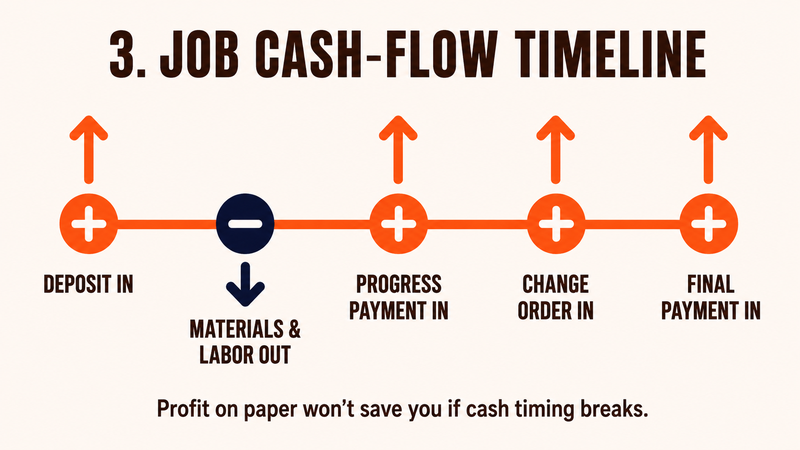
Busy does not mean profitable. Busy can put you out of business faster.
Track when money enters and leaves the job, not just the final profit.
My pricing rule is reverse pricing. First figure out what the job will cost you: materials, time, fuel, subs, manpower, dump fees, rentals, whatever it takes. If you are not confident in that number, add about 15% to cover your butt.
Then decide what profit you need to make it worth doing. Early on, you may take less profit. That is okay. What is not okay is taking no profit. You can learn on small profit. You cannot build a business by losing money and calling it experience.
Use written scopes. Be clear about what is included. Agree on payment terms up front. Document changes before extra work. Invoice fast. Compare estimate to actual. Update your next price.
Money needs to be boring and visible. Money in. Money out. What is owed. What is due. What each job taught you.
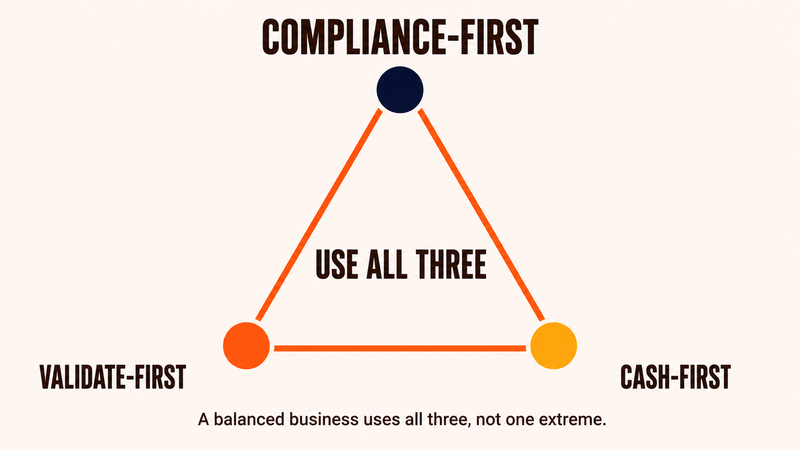
The three camps, and what each gets right
Use the useful part of each camp instead of getting stuck in one corner.
Compliance first launch
This camp says form the business, register it, get tax and bank setup handled, verify licenses and permits, buy insurance, and arrange bonds before selling regulated work.
What it gets right: you cannot build a real contracting business by ignoring the law. Licenses, registrations, insurance, bonds, and written rules matter.
Where it goes wrong: it can turn into a paperwork cave. New guys burn weeks acting like the LLC is the business. It is not. The business is someone paying you to do work legally and profitably.
Best use: do not do illegal work, but do not let paperwork become your hiding place.
Lean bootstrap and validate first
This camp says stay small, keep overhead low, win small jobs, collect reviews, and build systems as demand proves itself.
What it gets right: starting lean keeps you alive. You do not need a giant shop, a new truck, five apps, and ad spend before customers. You need legal work, visibility, and reviews.
Where it goes wrong: lean cannot mean uninsured, undocumented, careless, or invisible. If nobody knows what you do, you do not have a business. You have an idea.
Best use: start small, not sketchy. Use your network, Google Business Profile, reviews, referrals, door knocking, and local groups from day one.
Profit and cash first operations
This camp says the business has to be built around numbers from the start: cost, overhead, profit, billing, change orders, job costing, and cash review.
What it gets right: this is survival. It keeps you from buying revenue with underpriced jobs. It shows whether you are building something or just staying tired.
Where it goes wrong: it is uncomfortable. You have to ask for money, charge enough, track costs, and admit when your estimate was bad.
Best use: price in reverse. Cost first, add cushion if you are unsure, then set the profit. Take less profit early if you need to, but never plan to lose.
First ten jobs rhythm
For your first ten jobs, keep the rhythm boring:
- Research the rules before you sell the work.
- Stay inside the license, registration, and advertising requirements.
- Tell everyone you know what you do.
- Set up Google Business Profile.
- Ask every customer for a review.
- Write the scope before work starts.
- Price from cost, not from guessing.
- Add about 15% when you are unsure.
- Make some profit on every job.
- Ask for referrals from day one.
Repeat the simple habits until the business has proof and numbers.
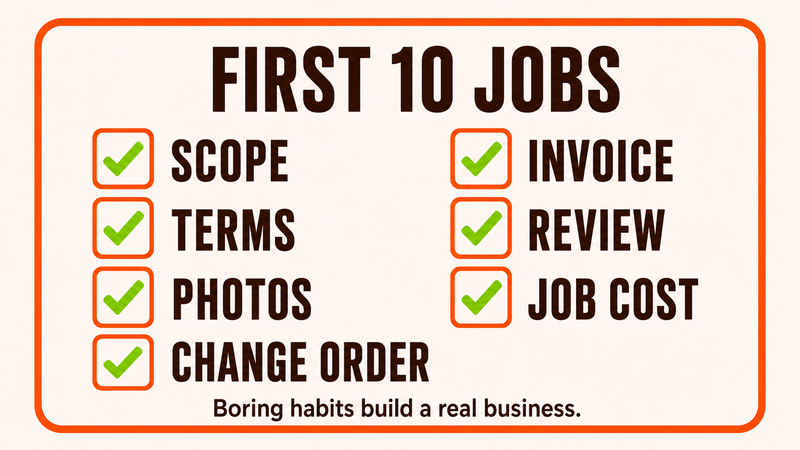
The playbook is not complicated: network, reviews, door to door, then keep repeating it. A lot in business is out of your control. The customer, the economy, the weather, the lead flow, the competitor down the street. So focus on what is in your control and do it consistently from day one.
That is starting right. Not looking big. Not pretending an LLC is a business. Know the rules, get in front of people, price for profit, and keep doing the boring stuff.
Sources
- dopl.idaho.gov: con faq
- sba.gov: launch your business
- sba.gov: choose business structure
- irs.gov: recordkeeping
- sba.gov: surety bonds
- Contractor lead generation how i get customers for my construction business
- builderprime.com: low cost marketing strategies that still work for contractors
- castagra.com: pricing your construction jobs profitably
- preferredcfo.com: 7 most common financial mistakes construction companies make
- knowify.com: construction cash flow mastery
- Idaho contractor license requirements
- South dakota contractor license requirements
- Nebraska contractor license requirements
- Iowa contractor license requirements
- Montana contractor license requirements
- California contractor license requirements
- Nevada contractor license requirements
- Hawaii contractor license requirements
- Arizona contractor license requirements
- Florida contractor license requirements
Go deeper
Use these as starting points, then verify your own state, city, county, trade, and job type.
-
U.S. Small Business Administration
A plain guide to planning, structure, startup steps, and early business basics.
-
U.S. Small Business Administration
A useful primer on sole proprietors, LLCs, and other structures before you file anything.
-
Adapt Digital Solutions
State-by-state contractor licensing articles to help you find the right starting point.